10 Key Takeaways from the 2025 PRINTING United Expo
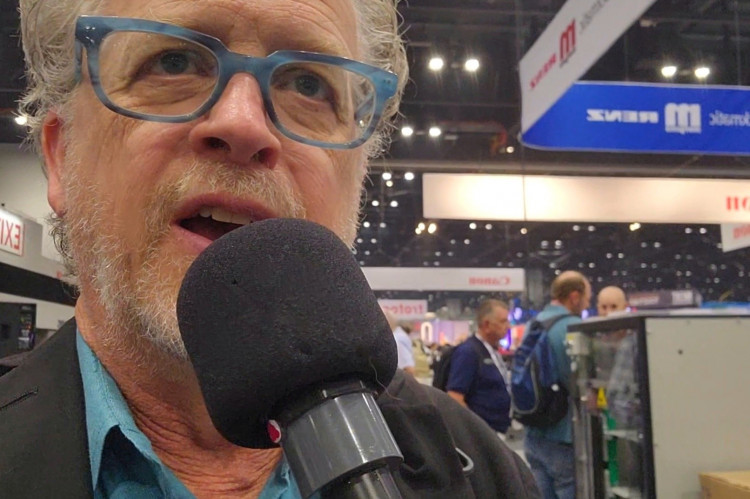

My sore feet are feeling better, all the laundry is done and put away, and I’m back at my desk. What hasn’t returned to normal are my impressions of the printing industry (in general) and the wide-format segment (specifically). Last week’s PRINTING United Expo demonstrated that the power of print is strong. That said, it isn’t the industry it was 10, or even five years ago. It’s different, and that difference is its lifeblood.
So, after a bit of contemplation, here are my takeaways from the event. What would you add to this list?
1: Wide-format Technology is Evolving
Increasingly, wide-format printing technology is being designed with production safeguards in place – systems of the types that have been in commercial printing technology for a while. As an example, Canon’s Colorado XL, which was introduced during the Expo, has optical systems that capture each pass of the printheads, as well as new systems to make micro-adjustments to printhead placement before significant visual deficiencies can take place. This can improve quality and profitability and eliminate spoilage.
2: Convergence Has Been Proven
In 2019, when PRINTING United Expo made its debut, the show was partially built on a hunch that the barriers between discreet, traditional print segments were weakened. In time for that show (Dallas), Alliance Insights (formerly NAPCO Research) had the data to prove it, and subsequent surveys have demonstrated its continuation. For PSPs, the Expo can be seen as a pool of opportunities from which they can draw new directions for their businesses, powered by the technologies and materials that serve in that opportunity area. Printing businesses are increasingly unique, driven by the diversity of the products and services they provide.
3: The Level of Interest in A.I. is High
For the first time this year, PRINTING United Alliance had a designated learning area focused on the use of artificial intelligence in the printing industry. Hatched as a “this is interesting to us” idea, the area proved to be immensely popular. Nearly every session presented was “standing room only.” Some had crowds spilling out into the adjoining aisles. And while the success of the AI pavilion was great to see, it illustrated an industry seeking direction on A.I., which will profoundly change the processes of PSPs, and the equipment they use, will operate. For those who have not seen it, Alliance Insights released a free report outlining current and intended use of A.I. Check it out.
4: Tariffs are a Complicating Factor
During the Expo’s annual Research Breakfast, Andy Paparozzi, chief economist at PRINTING United Alliance, presented an economic outlook for the industry, and stated while recent adjustments to tariffs have certainly affected PSPs, OEMs, industry suppliers (and, in some cases, their supply chain), it is the uncertainty of what he called “on-again, off-again” tariff moves that have added a veil of uncertainty for companies navigating today’s business environment. In discussions I had with a handful of wide-format equipment OEMs, all indicated recent tariffs to be a complicated factor.
5: Amid Uncertainty, Optimism Remains
The good news is that despite uncertainty, PSPs are making plans to move forward, and strong reports from exhibitors about contracts signed and qualified leads gained, provided fuel for that assumption. They are moving ahead, seeking what’s next, charting their paths. On this topic, I return to Andy Paparozzi, who says that times of uncertainty and downturn should be times to move forward, so as to better prepare for the recovery that will inevitably follow. In the discussions I had with wide-format PSPs during the Expo, I don’t remember talking to anyone who was not actively seeking solutions.
6: Printers are Questing for Opportunity
Returning to the concept of convergence, I think it is great to see wide-format (and other) PSPs following the opportunity they see for their businesses, even when those opportunities exist outside of their traditional spaces. And PRINITNG United Expo has proven to be the best place to do that: To find opportunities and adjacencies, new directions, and in some cases finding a new “North Star” to pursue. In a podcast I did with Dave Leskusky, president of PRINTING United Alliance, I described the Expo as being a 64-color Crayon box from which you can choose your own color to use – perhaps to even color outside the lines.
7: Promo is Growing as an Opportunity
Simply put, the promotional products industry is massive and represents a significant opportunity for wide-format producers and others seeking to move into that area. For some companies, moving into parts of the promo segment is not a heavy lift. It can be more an adjustment of thinking – another thing to sell – the technologies and materials used stay largely the same. For others, who choose to use, for instance, DTF, laser etching, and cylindrical inkjet technologies to image promo items, a capital investment may be needed to reach that opportunity. Regarding opportunity, it must be stated that these are digital imaging and decoration technologies, which can provide direct entre into full personalization.
8: Automation and Efficiency are Paramount
During the Expo, I witnessed a variety of new systems – both software and mechanical – that smooth and speed up work through the process. Over the past few years, there has been a growing desire for systems that make wide-format production more efficient, and that often comes down to automation. And, while part of this desire stems from labor challenges (see #9 below), automation should be seen as a much broader solution. It should also improve throughput, enhance product quality, and reduce spoilage and waste. It must improve profitability. For businesses competing in the increasingly competitive wide-format segment, profitability has become harder to achieve, thus making efficiency paramount.
9: Finding Qualified Labor Remains a Challenge
While this is far from being “breaking news,” I talked with numerous wide-format PSPs about the industry’s challenge to find and keep qualified labor is ongoing. And while this is inspiring many PSPs to seek automation as an intervention (see #8 above), automation cannot completely extract them from this challenge. Part of this reality stems from the fact that wide-format is largely a high-touch, custom business for which total automation is not affordable (and may not be achievable). The other part is that we need people – good, trained people who gain knowledge and expertise, thus bringing value to the business. That said, the current pipeline of workers is rather dry; those who succeed are doing so by building a strong workplace culture.
10: The Trade-Show Model Still Works
While there has been strong consolidation among trade shows serving the printing industry, leaving fewer shows annually, last week’s PRINTING United Expo provided strong evidence that there is still a place for trade shows in this industry. In an interview I did with Chris Curran, group president, media and events, for PRINTING United Alliance, he said there is nothing like being in the same room with the equipment or materials you’re considering, and I agree. I further think there is nothing like standing elbow-to-elbow with any of the event’s more than 30,000 registrants to share ideas and gain fuel to bring reality to our hunches. I’ve been to many trade shows since I entered the printing industry in 1991, and I can safely say the 2025 PRINITNG United Expo in Orlando was the best one yet.
The 2026 PRINTING United Expo takes place September 23-25 in Las Vegas, Nevada. See you there!
- People:
- Dan Marx
Dan Marx, Content Director for Wide-Format Impressions, holds extensive knowledge of the graphic communications industry, resulting from his more than three decades working closely with business owners, equipment and materials developers, and thought leaders.