


Printing Hope for St. Jude Children’s Hospital
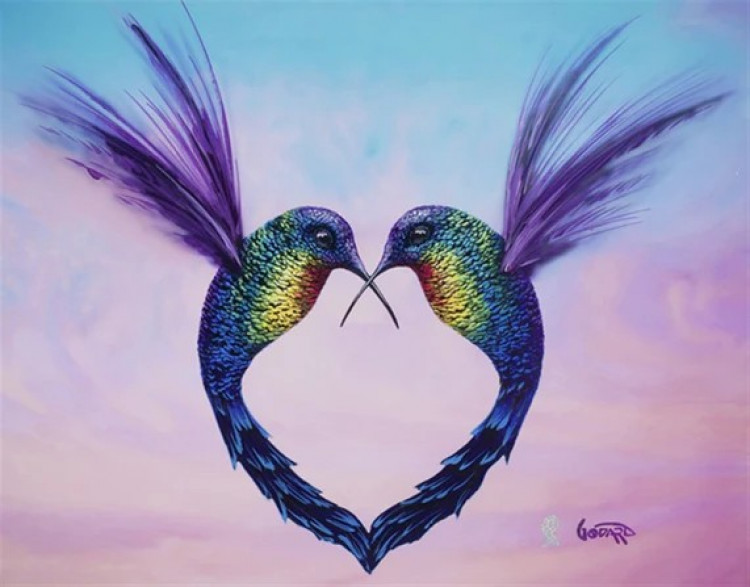

While on vacation in June 2025, I attended an art auction — admittedly more for the free champagne than because I intended to purchase anything. I came away from that auction with two pieces of art and a burning curiosity about another piece in particular — ‘Wings of Hope,’ painted by artist Michael Godard.
While you can hear more about the painting and the inspiring story behind it in Godard’s own words in the video below, what struck me was the print challenges he touches on. So of course, as soon as I was home, my suitcase unpacked, and my inbox cleared, I started tracking down who actually does his printing.
That led me to Nicholas Landis, president of Michael Godard Fine Art Associates. Landis is also president at Max Art Productions, the Las Vegas-based fine art printer founded to produce not just Godard’s work, but that of other artists as well.
Landis notes that Max Art Productions was founded around 14 years ago, when they were struggling to get the quality they wanted from the giclee printing process. “We ended up starting printing for ourselves just to kind of maintain the brand,” he notes.
That challenge led them to wide-format printing, with Landis noting that, about six years ago, they invested in their first flatbed, a Canon Océ device, and never looked back. Today, the company is running two Canon Arizona flatbed presses, although Landis notes they just purchased a swissQprint machine. “The Canon's a great printer — certainly a great printer for the money — but not quite fast enough due to the volume that we're doing,” he says. In time, he hopes to move all the work from the two he is currently operating to the new press. “We figure what would take us a week, it can do in six hours,” he says.
As for Wings of Hope, that, he notes, was challenging because of the materials and process used. They started off trying to use a Legion Paper mirrored substrate, but, Landis notes, they ultimately found and went with Dreamscape’s Silver Flash as their substrate of choice. They also used the material for an installation at Las Vegas’ Allegiant Stadium, which utilized layered printing techniques — techniques which were also applied to the Wings of Hope project.
“In that process, using UV printing, we got to play with a lot of different layered techniques to get different effects. We had a great time doing that project and adapted some of those lessons into the Wings of Hope to try to create that iridescent look that you probably noticed when you saw it. Without giving away all the secret sauce, that's it in general, and then the spot UV clear.” The UV clear is applied at the end to really help the effects pop. Landis points out, “Clear's been a really important way to touch up that last little finished part of the art.”
All told, Landis notes that Godard spent about three months painting the original piece, and around six months playing with the inks and substrates to really get something they were all happy with.
“And then the challenge really is the quality control,” he says. “When you're dealing with that silver metallic — and it doesn't even have to be silver, but metallic papers — you touch it wrong and the fingerprint shows through. The handling, the care, I mean, it truly is a white glove process.”
He continues, “That took a lot of R&D, finding the right primers to use, testing ones that worked and didn't work. We did find that the ink in the Canon does require certain care when it comes to how you're laying it down on that material. You can't really do a wipe off primer on the silver flash because it leaves the streaks. So, we ended up printing a primer, basically. That took a little bit to figure out. And then once we got to scale, it got a little painful, just doing that many — it's just a slow process. Each part of the printing, not including the painting, it just takes a long time.”
And as he states in the video, Godard does still hand-embellish each piece, continuing to make each one unique, despite the base painting being printed. And those “iridescent inks” Godard mentions?
Landis laughs, “I love that he said that. There are no iridescent inks, but we were able to get the iridescent effects by basically leaving out the white layer between the silver material and the ink. Depending on the opacity level of the ink you put down, you get that reflective iridescent effect. And then on top of that we put the spot UV down, which gives you even more movement as you walk by the art — that's really what grabs you.”
And Wings of Hope isn’t just a beautiful painting, it is also going to a good cause. While Landis isn’t sure exactly how many pieces they’ve produced for the series to date, he does note that they have donated hundreds of thousands of dollars to cancer research over the past few years from the sale of the painting.
“I don't know if it goes over it in the video, but the chance of his daughter's survival back when she was 16, which was I think 2006, was poor. Now you're in the 90th percentile where she would have had the opportunity to be cured; a lot of that has to do with the research going on with Saint Jude [Children’s Research Hospital]. So, it's just an important part of what we do.”
He continues, “every dollar counts, and we have the opportunity to reach a lot of people. A lot of individuals have a similar story of going through the challenge of cancer or losing a loved one. It's a great way to touch people and give back at the same time.”
It’s also a great example of wide-format printing, art, and the desire to give back all coming together in a stunning piece. And while Max Art Productions doesn’t sell the painting directly, Landis notes that if anyone is interested in purchasing one of the prints to help support St. Jude, they can reach out via the info@michaelgodard.com email address, and be directed to a local gallery that has it available.
Toni McQuilken is the senior editor for the printing and packaging group.
 The Mutoh ExpertJet 1462UF for Braille
 DEVELOPING: Brother to Acquire Mutoh
 swissQprint Previews ISA Flatbed Line-up
 Canon U.S.A. and DigiTech Launch Texas LT3 Series UV LED True Flatbed Printers
 All About TEXTUR3D Printing with Direct Color Systems
 Inkcups to Showcase High Throw Direct-to-object Printing at PPAI 2026

