


Under Pressure — Trends in Pressure-Sensitive Media

The latest trends driving the pressure-sensitive segment.
In the wide-format media space, one segment is rapidly seeing a rise in popularity: pressure-sensitive substrates. Pressure-sensitive media (PSA), in general, has three main elements — the printable face, the adhesive layer, and then a liner to protect the graphic from sticking to the press or anything else until it’s time for installation. They are traditionally used for applications like stickers, labels, and packaging, but as the category grows, so are the ways printers are using it.
What’s Driving this Surge
“One significant driver is the increasing emphasis on environmentally conscious materials,” notes Dan Lawellin, business development manager at Kernow North America. “These PSA constructions are designed to support brand owners in conveying their environmental message effectively. We’re witnessing a range of developments in this area, from the expansion of liner-less systems, to the development of recyclable and compostable adhesive materials that separate cleanly and don’t disrupt the recycling chain.”
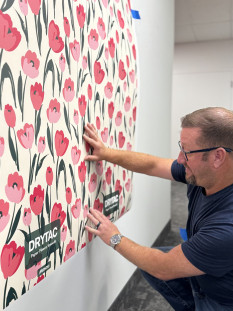
Taking the time to ensure you are matching the right pressure-sensitive media to the surface it will be installed on is a critical step. | Credit: Drytac
Another trend, notes Laura Slovensky, segment manager – graphics at Nekoosa, is the evolution of printing technologies. “One of the most significant recent developments in the pressure-sensitive media space is the introduction of UV-cured adhesive technology for graphic applications,” she says.
Ease of installation of these materials is another driving factor. Amanda Lowe, global marketing director at Drytac, notes, “Recent developments focus on ease of installation and versatility across a wider range of surfaces. Manufacturers are introducing media with air release liners to simplify bubble-free application, as well as products designed for rough and textured surfaces.”
Finally, it’s all about the end-use itself. Beyond just stickers, more brands are looking for new options for their branding. “We are seeing both demand for very low tac adhesives for removable marketing and promotional applications for very short-term use, and for very aggressive adhesives for low energy surfaces-such as plastic,” says Al Grant, marketing manager, Fusion Digital Paper.
Beyond these high-level trends, brands and printers alike are looking to move away from traditional vinyl options, which is also driving adoption of PSA materials. But at the same time, printers need materials they can run through machines easily for faster turn-around times without compromising on quality or integrity. Brands are now demanding fast, inexpensive, AND high quality — they are no longer content to pick just two. PSA materials are proving to be a great option for printers looking to hit those marks.
Lawellin notes, “When we look at products like our pressure sensitive media for large-format, experiential retail and interior décor never really left — they evolved. Brands are refreshing spaces faster (walls, windows, floors, fixtures), which favors PSAs that install quickly and come off cleanly without repair work. Short runs and constant creative swap-outs mean removability is part of the brief. Labor is tight, so anything that saves minutes per panel is a win. And on the packaging side, sustainability/compliance moved from ‘nice to have’ to ‘baked into the spec,’ so adhesives now have to prove they don’t mess up recycling.”
That point was echoed by Lowe, who points out, “The shift toward short-run, custom, and on-demand print has pushed the development of pressure-sensitive films that are quicker to apply, reposition, and remove. At the same time, growth in wide-format and digital printing has created demand for media that can handle more complex graphics, deliver consistent print quality, and reduce installation time.”
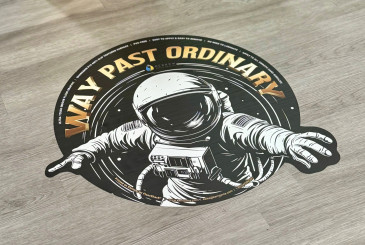
Floor graphics remain a popular application for pressure-sensitive media, as it can provide both vibrant graphics as well as a safe surface for walking. | Credit: Kernow
That’s where we are today — where are PSAs going next through? What will drive tomorrow’s adoption of the materials and drive the next generation of innovation?
Slovensky believe it will be an acceleration of the current trends. She notes, “Over the next 12-18 months, we expect UV-cured adhesives to continue gaining traction. The versatility of this adhesive technology allows us to create unique pressure-sensitive substrate solutions that address the most challenging graphics applications.” As the press manufacturers continue to push the bar on things like inks, coatings, and speed, the PSA materials will continue to evolve to keep up and open new opportunities.
Getting The Most from Your PSA Materials
If you aren’t already running PSA materials, odds are your client base is going to start asking for applications that make use of it sooner rather than later. And if that’s the case, you’ll need to make sure you prepare your team and equipment for success.
Grant stresses that knowing what kind of installation will be needed is critical. He says, “Depending on your application, you may need professional installers. If you have a wallpaper project for a large area, professional installers would probably be prudent. If you are working on some smaller marketing/promotional signage and your printed product has repositionable adhesive, then a novice can install the product.”
Lowe also notes that not all PSA materials are the same — choosing the right one for each job is a critical factor. “Printers should always match the right media to the application — considering surface type, environment, and duration of use” she stresses. “Proper surface preparation is essential, as even the best adhesive won’t perform on a dirty or unstable substrate. For installation, working methodically with the correct tools, maintaining consistent pressure, and avoiding overstretching the film will help ensure a smooth, professional result.”

Pressure-sensitive media options are varied today, with some being easy to remove and reposition, while others are designed for more permanent installations. | Credit: Neksooa
“Prep matters…a lot!” says Lawellin. “The success of the material depends on the weakest link, and that is often the surface preparation. You should always clean the surface thoroughly with either soap and water or IPA (isopropyl alcohol), depending on what you are working with. Confirm that any fresh paint is fully cured if you’re applying to painted wall. Check that any existing surface treatments are not loose or peeling, such as old varnish if you’re installing a floor graphic. It helps to make sure the surface is warmed up if it’s cold. Ultimately, even the best adhesives can fail if the surface isn’t properly prepped.”
Finally, make sure to test each surface and material choice before ever getting to the print and installation portion of the job. You can catch a lot of problems early with elements like surface prep and material choice by making it part of the discovery process to run a test in the actual environment where the graphics will go. Even things like an exterior wall might perform differently based on factors like the varying environmental conditions it has been exposed to over time. So, whenever possible, go out to the actual site to run the tests. And have a good selection of in-house testing surfaces to experiment with for those times when distance or turn-around times make live-site testing impractical.
Pressure-sensitive materials will only continue to grow in popularity. Today’s wide-format presses can print on a much wider variety of substrates, opening up new applications and markets you can target without any additional investments. It’s worth getting a few samples from different media suppliers and letting your team start playing — you might be surprised where your next big application comes from, and PSA materials will lead the way to innovation.
Toni McQuilken is the senior editor for the printing and packaging group.
 Sleek Signs Turns to Drytac ReTac to Reimagine Converted Church
 Avery Dennison Launches Neo Matte Black Paint Protection Film
 Roland DGA Announces Launch of Two New Media Offerings
 Drytac to Exhibit at PRINTING United Expo 2025
 Avery Dennison Unveils Exclusive Supercar Blondie Collection
 Digidelta's Decal Bubble-Free Now Available Worldwide

