


When Print Meets Promo: How Printers Are Expanding into the Promotional Products Market
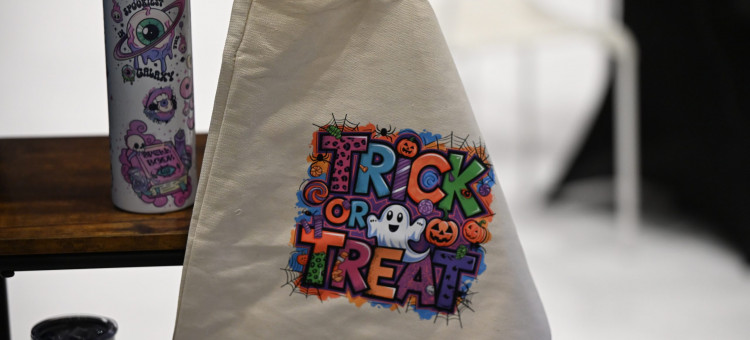

At the intersection of print and promotional products, a powerful shift is underway. That transformation was the focus of a recent panel discussion held during PRINTING United Expo, and moderated by Brendan Menapace, content director – Print & Promo Marketing with Advertising Specialty Institute. He welcomed three industry professionals: Linda Fox of SpeedPro Nashville South; Kent Ross of RP&G Printing; and Gordon Klepec of American Solutions for Business—shared how and why they expanded into the promotional products market.
Their experiences reveal not only how natural this expansion can be, but also how critical it has become for printers looking to grow, diversify, and retain customers.
Opportunity at the Customer’s Doorstep
For Linda Fox, promotional products became impossible to ignore once her customers began asking for them. As the owner of a Nashville large-format print company, Fox regularly produces banners, backdrops, and event graphics. But her clients increasingly wanted more: lanyards, wristbands, branded items for festivals, and custom products for corporate gatherings.
During the massive CMA Fest in Nashville, she says, she fully recognized the demand. “People needed wristbands, napkins, toothpicks—you name it,” Fox explained. “I realized I was missing the boat.”
She joined ASI last year, attended the Chicago ASI Show, and returned with samples and ideas that helped her quickly integrate promo into her business. The shift aligned perfectly with what many printers are discovering: customers now expect a one-stop marketing partner, not separate vendors for print and promo.
A New Revenue Lifeline for Printers
While Fox entered promo to expand, Kent Ross turned to it to survive. After more than 40 years in print, he watched the decline of traditional products such as business forms and checks. “What’s left of that business just isn’t profitable anymore,” he said. For his business, promo became the solution.
The transition required no significant investment in new machinery, and Ross found that promotional products created recurring orders in a way print rarely does. “Once a client does an event with you, they come back every year,” he noted.
Promo also gave Ross new marketing angles. “You only buy envelopes when you need envelopes,” he joked. “But I can run a storm-season sale on umbrellas and get your attention.”
His showroom, which is filled with samples, has also become a silent salesperson. When clients visit for print work, they often pick up promo pieces, then start asking questions and place additional orders on the spot.
Scaling the Convergence of Print and Promo
As Fox and Ross illustrate individual transitions, American Solutions for Business (ASB) demonstrates what happens when this convergence scales. Founded in 1985 as primarily a print company, ASB now operates with more than 650 sales reps nationwide—and its business mix has flipped to roughly 60% promo and 40% print.
“We’ve evolved into a full-service partner,” said VP of Sales Gordon Klepec. “New reps often come in promo-first, while long-standing reps are learning to blend the two.”
Technology plays a major role. ASB uses e-commerce platforms and database-driven search tools, integrated with ASI’s networks, to streamline sourcing and reorders. Vendor relationships are another pillar of the model. “Our suppliers are eager to help,” Klepec said. “They provide spec samples, self-promos, and ideas. Their main complaint is that we don’t use them enough.”
He emphasized the advantage of saying yes to urgent or high-volume requests. When Subway needed 250,000 T-shirts under tight deadlines, ASB delivered—and that opened the door to deeper partnership discussions, mirroring success the company has seen with other brands, like Chipotle.
What Printers Need to Know Before They Start
The panelists offered several insights for printers entering promotional products.
Ross stressed the importance of boundaries: “Don’t be afraid to say no. If a brand-new client comes in with a rush order, that’s a red flag.” He encourages printers to charge rush fees—even when vendors don’t—because expedited jobs require extra oversight.
Klepec advised simplifying product presentations. Instead of overwhelming clients, he recommends offering good, better, and best options. “You’ll be surprised by what they pick,” he said.
Fox says she continues to embrace the learning curve. A three-day turnaround on festival wristbands became her first major promo victory. “Customers tell me what they need, and I make it happen,” she said. “I’m learning every day.”
Looking ahead, the panelists agreed that customization and print-on-demand will shape the future. Clients increasingly want personalized, small-quantity items rather than large inventories. Promo is also evolving from a giveaway marketing category into a revenue-generating one, as brands launch e-commerce stores to sell their merchandise.
Printers entering promo aren’t just diversifying. They’re transforming their businesses into comprehensive marketing solutions. As Ross summarized, “Promo and print complement each other perfectly. It’s not an either/or.”
For printers willing to expand, this convergence offers not only new opportunity, but a new identity for the modern print shop.
Dan Marx, Content Director for Wide-Format Impressions, holds extensive knowledge of the graphic communications industry, resulting from his more than three decades working closely with business owners, equipment and materials developers, and thought leaders.
 New Study Finds Convergence Across Print Segments is Delivering Revenue and Profits
 The Broadcast: Exploring the Promotional Products Opportunity
 Profiting Through Convergence: How Print Providers Are Winning Across Market Segments
 TentCraft Explores Rental Program
 10 Key Takeaways from the 2025 PRINTING United Expo
 The Broadcast: Exploring the Value of Industry Data

