


From Outsourcing Threat to Wide-Format Success at Colorado State


The following article was originally published by In-plant Impressions. To read more of their content, subscribe to their newsletter, IPI E-News.
When Steve Burn heard there was a request for proposal (RFP) to outsource Colorado State University’s print shop (FastPrint), Burn all but said “not on my watch.”
But let’s start from the beginning. Almost two years ago, Burn, director of Central Receiving at the Fort Collins, CO, university, expressed an interest in printing to his vice president.
“I just kind of tossed a little bug in his ear that I have an interest in the print world. It is a trend across the country that higher-ed is doing a lot of merging with mail facilities and bulk mail facilities … and there's just benefit in that,” Burn says.
That was around the time when Burn found out about the RFP. The university’s print shop was reporting to marketing and communications back then. Burn did not sugarcoat his feelings about that RFP; he told the department it was the dumbest idea he’d ever heard.
“I told them it wasn’t arrogant, it was just facts. And when my vice president asked me if I was interested in acquiring it, I told him ‘yes,’ and he told me to put some facts together to help build my case,” Burn says.
He contacted Mike Loyd, executive director of the In-plant Printing and Mailing Association, and Bob Neubauer, editor of In-plant Impressions’ and between the two of them gathered articles and studies to help build his case.
“So basically, I cleaned everything up and made sense of it and sent that over to my IT manager,” recalls Burn. “And I said, ‘Richard, can you build us a website? I can't forward these emails to our vice president and expect him to digest this.’”
The website was built and the president received a link to it. “And he called me up a couple days later and essentially handed me the keys,” Burn says.
From there, Burn went through the process of adopting the print shop. He credits IPMA and IPI with helping him keep his in-plant alive.
“It sure wouldn't have been as slick and factually justifiable without all of the data that they openly, willingly, helped out with,” Burn praises. “So that is why I'm sitting here and have our print shop under us today, and we're growing like crazy right now. So, it's pretty exciting.”
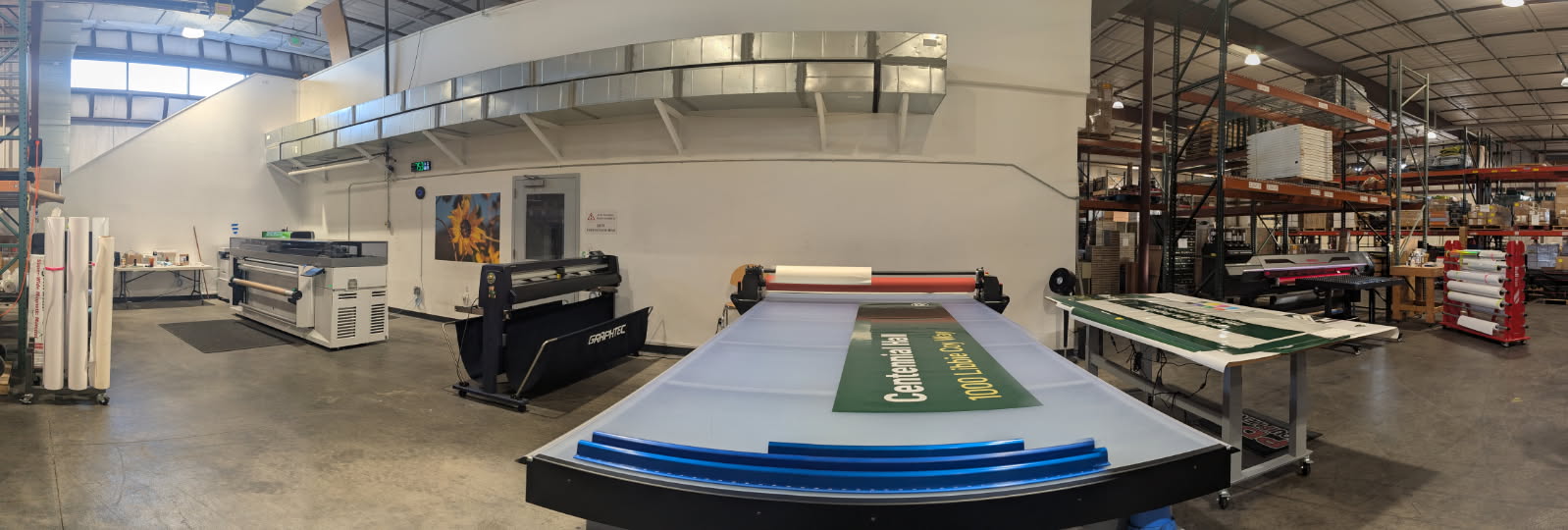
A wide view of all the recent installations at Colorado State University FastPrint, including the Canon Colorado, Graphtec cutter, Kala application/laminating table, and Mimaki UJ330H-160 hybrid UV-LED printer.
But with growth usually comes some growing pains, and Burn explains that handling new staff and new personalities was one of his biggest challenges throughout this process.
“Coming in with these guys who have been doing this for years and trying to gently put in some input from what I knew from my colleagues and peers, that was a challenge, but we got through it,” Burn says.
Today, the shop has a new manager, Tim Griffin, who Burn says is excellent even under the added pressure of starting at the end of the school year.
“He has done a fantastic job,” Burn says. “He kind of got pushed into the fire because he started right when … the school year was ending, which is a crazy time. And then, of course, you turn right around and the school begins again, and our fiscal year rolls around, so it's just been absolutely gangbusters, since he started.”
Altogether, the print shop has three full-time and three student employees.
Expanding Into Wide-format
Before CSU President Amy Parsons started in 2023, Burn says the in-plant’s first dip into the wide-format pond was posters that were mounted to foam core board. Then the new president took a spin around campus and everything changed.
“She's driving around campus, looking at all of our building signs, and this campus has about 60 years of different building signs. They're all differently branded. They're all faded differently. Some are new, some are 60 years old. Some are black, some are green. She's like, ‘I want all of the signs replaced.’”
So facilities got a quote for the work from an outside printer for nearly $150,000. It raised a few eyebrows.
“So, facilities called me up and said, ‘Hey, can you, can you do these signs?’ And I said, ‘No, we cannot.’ I explained to them, ‘We don't have that equipment now, but this type of a project would help us make that leap if you're willing to take a gamble on me.’”
After that, Burn started shopping around. At PRINTING United Expo, he fell in love with Roland and Mimaki flatbed printers, though he knew he didn’t necessarily have the space for them. So he set his sights on the Canon Colorado.
“That was a little bit rich for our blood at that time,” Burn says.
But because Burn was working with UBEO Business Services, an office technology solutions provider, he was offered a demo unit for a much lower price.
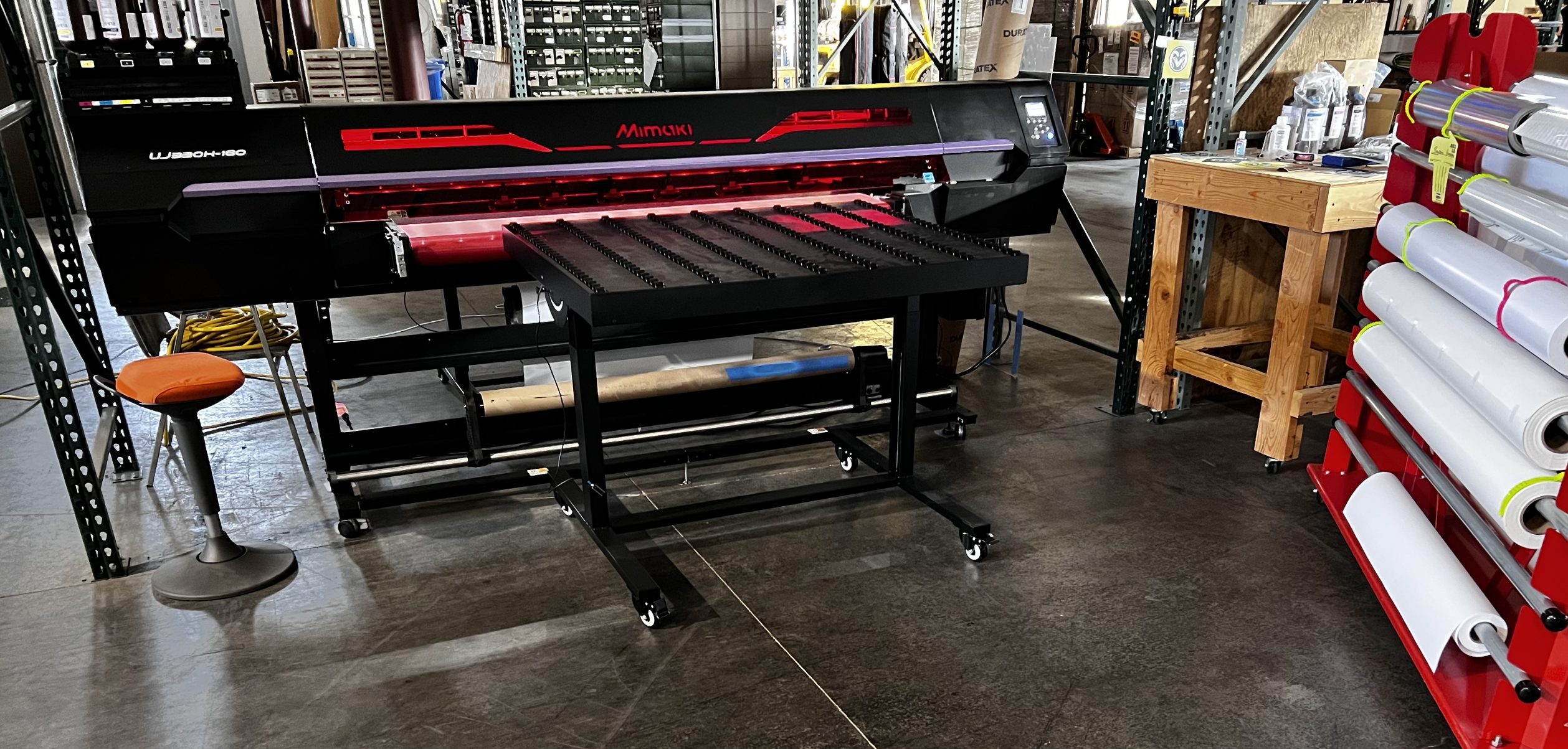
The new Mimaki UJ330H-160 hybrid UV-LED printer at Colorado State University FastPrint.
In addition to the Canon Colorado, FastPrint has also acquired a Graphtec cutter, a Kala application/laminating table, and a Mimaki UJ330H-160 hybrid UV-LED printer.
“The Mimaki ultimately gave me everything that we needed because, essentially, it’s a flatbed, but it's in a roll-to-roll- format that’s more compact, Burn says. “And we’re printing these building signs, which is being printed on a 3M reflective material.”
So far, Burn and his team have made signage for approximately 40 out of 200 buildings on the main campus. He estimates it will take a year to complete the project.
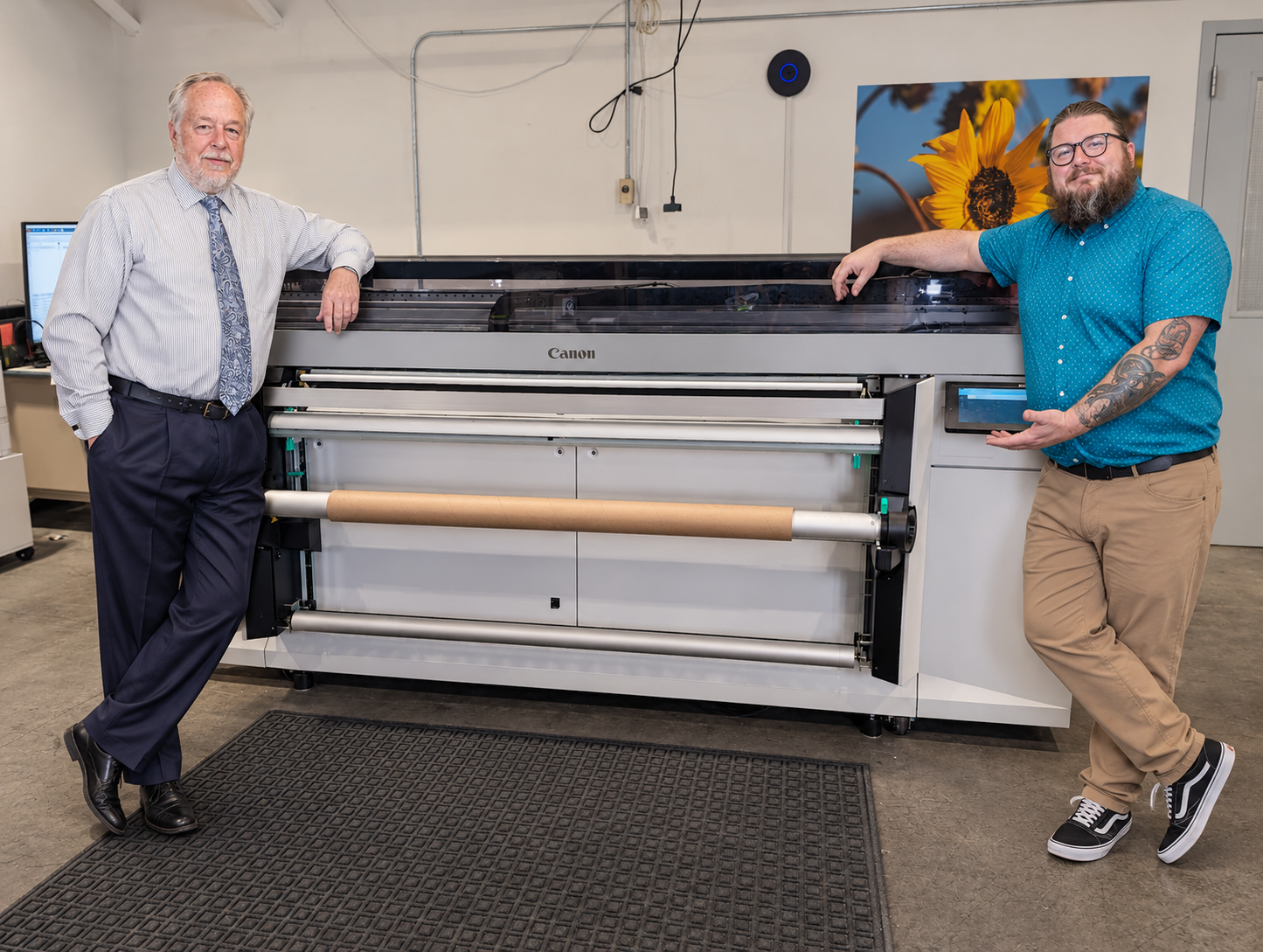
Steve Burn (division director), and Tim Griffin (print manager) stand with FastPrint’s new Canon Colorado wide-format printer.
This work has led to other jobs, as people see what the in-plant can do.
“Our bookstore found out that we were doing this, and [asked] ‘Can you do some stickers?" and I told them ‘sure’ and asked how many they need and he's like, ‘Oh, just a few hundred.’ And then it turned into 15,000,” Burns says.
Then the marketing and communications department approached him about providing print support for a city-wide rally.
“We're working with the city of Fort Collins, and we built a website for all the businesses in town to be able to go to, and then they can place orders for free for things like window clings, stickers, buttons, stuff like that,” Burn says.
As part of this marketing campaign, the in-plant printed more than 30 popup banners for local hotels and restaurants and well over 10,000+ stickers and double-sided window clings, he adds.
“We are currently working with Athletics to start replacing stadium and locker signage,” he says. “All this work is pushing itself in the door, and we’re even trying not to advertise.”
Above all, Burn wants to emphasize that this wide-format growth wouldn’t have been possible without the help of his industry peers.
“The kindness and generosity is what made all of this happen,” he says. “[The in-plant] wouldn’t be here if it wasn't for all of my peers. I definitely bounced a lot of ideas off of them, and it's been an amazing journey.”
To view the website Burn created to convince his boss of the benefits of in-house printing versus outsourcing, click here.
- Categories:
- Business Management - Industry Trends


