The Automation Imperative: Print is Reinventing Itself and You Should Too


The following article was originally published by Printing Impressions. To read more of their content, subscribe to their newsletter, Today on PIWorld.
For print service providers (PSPs), shifting markets and changing expectations while still getting product out the back door on time is a huge focus, and can be a challenge. The reality is that print and packaging manufacturing are just a part of a much bigger and wider supply chain. The technologically-driven changes in communications and information distribution have placed new demands on supply chains, including CPGs, print, publishing, and packaging service providers and those that support them. Companies and even consumers are increasingly moving from very analog processes to digital data driven processes. Connecting and sharing this data is what will bring siloed companies and process automation to the entire supply chain. Changing a business or production infrastructure is an imperative at the core of a business and can be a very challenging process.
To address these new and changing realities, it is important to develop workflows that support the products and product mix with optimal efficiencies. Currently, most work is handled on an exception basis. This means that most jobs require manual handling whether needed or not. While manual handling is probably needed for a small percentage of work, companies really need to focus on automated workflows with exception handling as needed.
What is the goal?
The diagram below is from the PRIMIR Transformative Workflow Study and provides a high-level look at a future proof infrastructure that will support the demands of current and changing market realities. This graphic is actually an updated version of a diagram I published in Seybold Reports in 1997. Obviously, the devil is in the details, but this gives you a good idea of how you should be thinking about transforming your business infrastructure.
The key concept is around cross process integration while preserving process modularity.
Transformative Workflow Reference Model Overview

Click to enlarge.
In the diagram, you can see the internally focused (identified by the beige background) task groupings; Production, Process Management, Business & Information and the increasingly important External Interface. You will notice that in each task group there is "horizontal" integration between the task components. Likewise, you will notice that there is vertical integration between each task group.
Increasingly, many of the business and production "workflow" systems that are available address at least one task grouping. Some with provisions for vertical integration, including Print MIS/ERP systems, print workflow systems, and "full featured" DFEs that are married to each device. Today, most of these task group solutions do support limited vertical and horizontal integration, but not necessarily component task modularity. While this is a good start, as we look at the market requirements for today and the future, it is equally important that each of the components are modular as well. This modularity provides the flexibility needed to adjust to the continuing requirement changes with minimal effort and expense.
The Cloud, and its growth has become the platform for the connection of these disparate participants in the supply chain. With this, we are finally able to bring real world experiences to machine learning and ultimately use that as a base for AI-driven supply chains. While artificial intelligence (AI) is front and center in general communication today, for PSPs it will ultimately be a combination of Intelligent Automation (IA) and AI in combination to achieve the maximum advantage.
Onboarding and Processing Jobs
As printing and converting firms are faced with pressures from customers to speed up turnaround time and drop prices, they need to turn to workflow automation to help squeeze efficiency from their operations. Data and content are leveraged throughout the business and production process to help automate the entire workflow, which can increase efficiency and reduce costs by eliminating as many human touchpoints as possible.
It starts with the client, and bridging the client and the PSP can really be divided into two separate operations: bringing a new customer into your production ecosystem, and then entering the jobs into production. There probably isn’t a one-box solution that can satisfy all of the requirements for all customers, since the clients each have unique business systems and production processes, although many have tried.
Short of Electronic Data Interchange (EDI), which offers the most direct route of communication between clients and the production plant, Web2Print performs a level of indirect bridging and communication. Most of these solutions offer "constrained design" template-based solutions that streamline the ordering and production of a library of products. However, what percentage of "your" products and customers would fit that model? In my experience and research, with a wide variety of PSPs, it averages about 20% of the total input if offered at all. Understanding this and defining how to position your growth will directly affect your margins, since printing services will usually garner a higher margin albeit a lower volume.

Click to enlarge.
For the majority of printers, as you look at automation to optimize your plant, you need to identify whether your incoming work is custom/ad hoc or based on a catalog of customizable constrained designed products. Or perhaps we can take it a bit further; if some of your work falls into that category, does all of your work? And if not, what do you do with the balance? In an era where digital print technologies have removed or automated many of the prepress and production steps in the process, for many, the bottleneck has moved from the production floor to the order entry process. In addition to bridging the client and the PSP, the value of onboarding is really its ability to drive the onboarded jobs into a production workflow.
Manufacturing Automation
Automation is now a requisite to a profitable print or packaging company, and needs to provide for centralized business and production management. The use of application programming interfaces (APIs) for a solution is an important feature, and increasingly these onboarding solutions are designed integrate it with business (ERP/MIS) and a production system. When working with any data-driven system — and today that includes print and packaging manufacturing workflows — you need to be able to support getting the jobs into and through the plant in as efficient and painless ways for both you and your customers. An Intelligent Workflow Infrastructure needs to be implemented through a deep understanding of a PSP's existing and future products, markets, and processes. With that it becomes much easier to develop the solutions, supporting structures, and go-to-market strategies for the short and long term.
While it is getting better, much of the current "off the shelf" workflow software and professional service offerings are developed around legacy processes, technologies and markets. Today and going forward, they need to be developed and aligned to support newer and disparate technology and markets. Building a one-size-fits-all solution will usually fall short of those goals. Ultimately, the solution needs to fit the specific needs of a PSP and their disparate customer and partner relationships.
Plant Level Automation
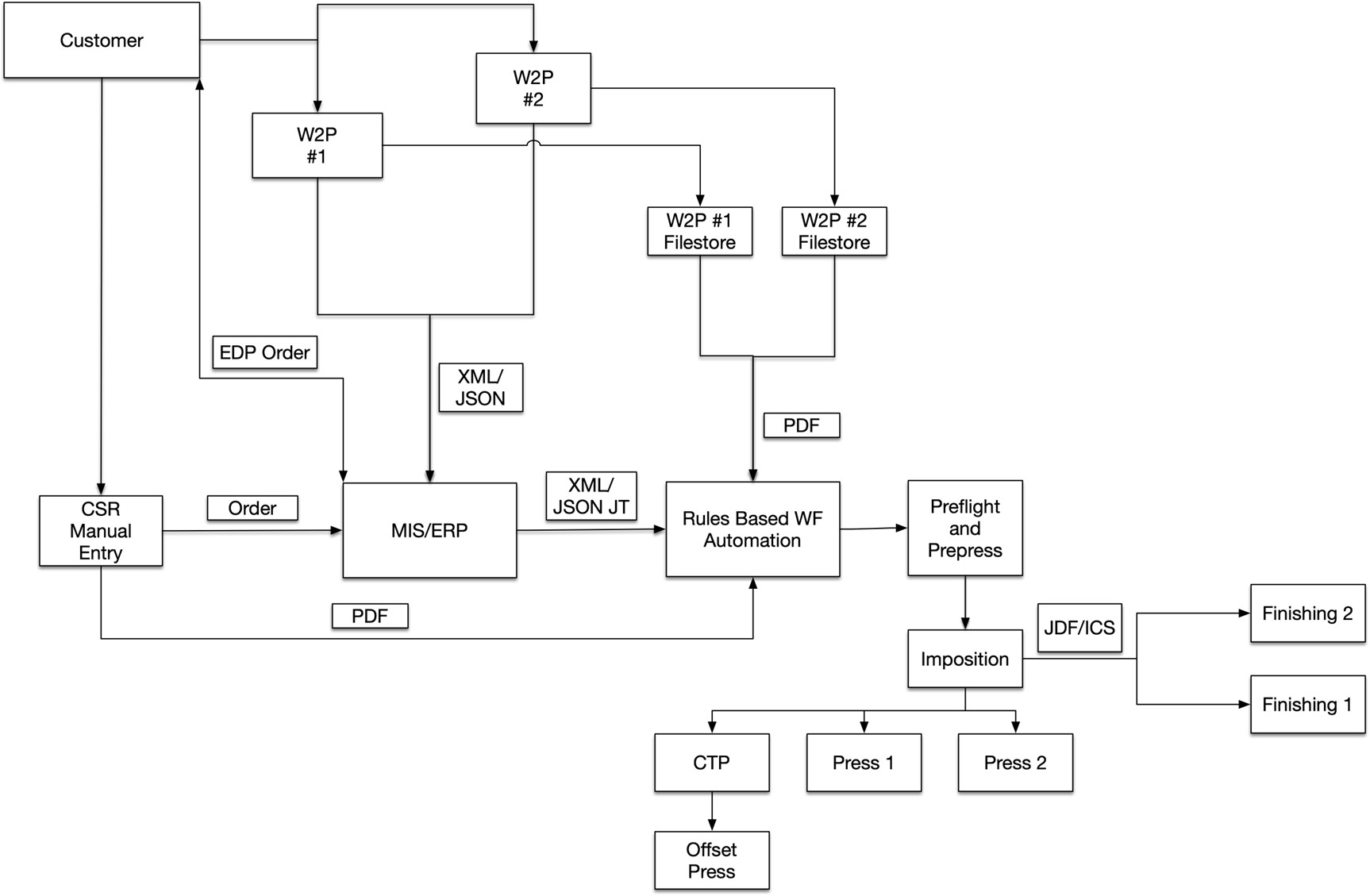
There is no one-size-fits-all workflow solution. With the expansion of a PSP's products and services, managing it all through automation while minimizing touches is a new concept to many. The solution for many PSPs has been to create processing silos, which are cumbersome and don’t fully provide the flexibility needed to shifting demands or for centralized management. However, there is a common thread throughout that provides the support of an intelligent workflow infrastructure. In my experience, rules-based automation is the most flexible automation platform, and the available offerings are growing. The key to optimal automation opportunities is collecting all of the xml/JSON job tickets from the MIS system and then designing your flows for onboarding normalization.
The diagram below is an example of how a generic automated workflow could look:
Click to enlarge.
The reality is that even with automation, there will be some need for some exception handling. This can be easily handled with checkpoints and appropriate notifications. For example, if a job is missing pieces or the job doesn’t align with the job ticket, it should go back to a CSR (or the customer if desired). If it fails in process, it should go to prepress for manual intervention, etc.
What is the end game?
As we continue the digital journey toward Industry 5.0 and more automated and integrated procurement and production processes, new skills are demanded across the value and supply chains. Onboarding the production and order data, normalizing them and capturing and returning the resultant performance is the new prepress. Connecting and tailoring all of the necessary individual component solutions is a new and critical requirement for many if not most companies of any size.
The PSP and their customer are both a part of a value chain ecosystem, and as such their individual processes need to be closely aligned and bridged with each other. Furthermore, since the customer sits at the top of the chain, any solution needs to be focused on them. Of course, since it is one ecosystem, it also needs to support the requirements of the PSP as well.
The preceding content was provided by a contributor unaffiliated with Printing Impressions. The views expressed within may not directly reflect the thoughts or opinions of the staff of Printing Impressions. Artificial Intelligence may have been used in part to create or edit this content.
David Zwang specializes in production optimization, strategic business planning, market analysis, and related services to companies in the vertical media communications market. He can be reached at david@zwang.com.