


Tackling the Cutting/Routing Bottleneck
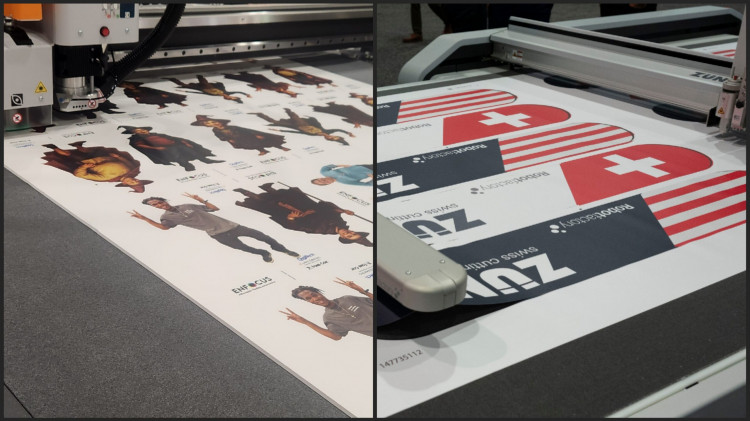
As wide-format print service providers (PSPs) continue to push the boundaries of speed, substrate versatility, and application diversity, one area remains under constant pressure: finishing. While cutting and routing equipment has evolved rapidly in recent years, it is often where many shops encounter bottlenecks. With wide-format producers making everything from retail displays to architectural graphics, it’s imperative that they stay abreast in the cutting and routing realm. Wide-format Impressions chatted with industry experts from Zünd and Kongsberg PCS to discover the latest tips, tools, and trends shaping digital cutting and CNC routing technology.
The Finishing Bottleneck Evolves
If you ask Beatrice Drury, communications manager, Zund America, she says that, in many shops, the finishing department has become the new production constraint.
“Wide-format PSPs began facing bottlenecks in finishing when, for various reasons, digital printer speeds started increasing faster than cutting speeds, shifting the constraint from printing to digital finishing,” Drury says.
Even as hardware and workflow automation have improved, Drury says “a significant gap remains, especially in applications involving complex finishing operations.”
Dimitri Van Gaever, Global Marketing Director, Kongsberg PCS, agrees. He explains that PSPs are no longer cutting the same rigid boards day in and day out – now it’s anything from stretch textiles and recycled paperboards to dense aluminum composites and honeycomb panels – so the range of substrates demands both precision and flexibility.
“Skilled labor shortages, rising material costs, sustainability demands and tight turnarounds continue to challenge print service providers (PSPs). Alongside this, PSPs are working with a wider variety of materials which behave differently in the cutting process,” Van Gaever says. “As a result, these businesses are increasingly having to explore how investment in solutions such as automation and smart finishing could enable them to maintain productivity with fewer manual steps, also allowing them to deploy skilled labor in other areas of the business.”
Choosing Between Digital Cutters and CNC Routers
For wide-format operations considering a new investment, the decision between a digital cutter and a CNC router is rarely simple. The right choice depends on materials, applications, and production goals.
“Shops should evaluate their dominant applications and materials and determine how important versatility and flexibility are in their ability to continue satisfying customer demand,” Drury advises. “Production volumes and the desired level of material-handling and workflow automation are important considerations as well, as is the ability to integrate easily into existing production environments.”
She explains that CNC routers are best at handling very thick, dense sheet and board stock (acrylics, wood, metals, etc.). However, if you’re having trouble deciding what equipment is right for you, multifunctional digital cutters can handle all different types of substrates.
If you ask Van Gaever, he’ll tell you that there is no universal solution, but that Kongsberg does its best to work with its customers to help gain a better understanding of what they need.
“At Kongsberg PCS, we don’t just offer a one-size-fits-all solution. We evaluate the current needs and growth aspirations of our customers’ businesses to recommend the best from our Kongsberg and MultiCam product portfolios,” he says. “For example, for PSPs producing shorter runs of signage and packaging applications, digital cutters are typically better. However, for businesses working with thicker materials such as PVC and wood, for example, CNC routers are more suitable.”
It's Not One-Size-Fits-All
When it comes to making the decision on the right cutting/routing equipment for your print shop, Drury advises that multiple factors like workflow, application mix, and production environment all play a role.
"Shops should evaluate their dominant applications and materials and determine how important versatility and flexibility are in their ability to continue satisfying customer demand. While CNC routers are best at handling very thick, dense sheet and board stock (acrylics, wood, metals, etc.), multifunctional digital cutters like Zünd excel at handling a remarkably wide variety of flexible to rigid, thin to thick materials," Drury says. "Production volume and the desired level of material-handling and workflow automation are also important considerations as well, as is the ability to integrate easily into existing production environments and ERP/MIS systems."
Materials Driving Growth
It’s important to also keep an eye on material trends, because they are also reshaping tooling requirements.
“Textiles for soft signage and décor, as well as ecofriendly substrates, are among the fastest growing categories, neither of which are routing applications,” Drury says. “For efficient processing, the former demands appropriate tension control in feeding/advancing from rolls along with efficient optical registration to precisely match cut to print. The latter calls for high-performance oscillating and V-cut tools.”
Sustainability is also accelerating substrate changes.
“The biggest change we are seeing is the transition to more recycled, paper-based sustainable materials, which can be more challenging in the cutting process due to their composition and structures,” Van Gaever says.
Van Gaever also notes that rigid signage is continuing to evolve as well. He says that aluminum composite materials, such as Dibond, are growing in premium signage and retail applications.
“These denser materials often need appropriate tools, feed rates and spindle speeds to avoid delamination or heat build-up,” Van Gaever says,
Automation: From Luxury to Necessity
It’s clear that automation has shifted from being optional to being essential. As Van Gaever states plainly, “Automation can no longer be seen as a luxury – it’s the key to staying efficient and profitable.”
It is in high-volume wide-format shops, Drury says, that automation reduces time-wasting touch points and labor requirements.
“[Automation] minimizes the handling bottlenecks common in high-volume, wide-format environments, Drury says. “Automated loading, unloading, tool changes, and workflow integration increase throughput while maximizing equipment and material utilization and even reducing errors and mis-cuts.”
Van Gaever points out that consistency and time-to-market are additional benefits, and with automation, there is less room for human-caused mistakes and quicker turnaround times.
“The 100th sheet,” he says, “is processed with the same precision, accuracy, and efficiency as the first sheet, which eliminates variations caused by human errors.”
Software Integration Matters
Increasingly, wide-format workflows depend on seamless digital handoffs. Van Gaever emphasizes that PSPs with cutting equipment should ensure that their file preparation workflow aligns with their cutting table front-end software. That capability, he says, “is essential for reducing set-up time and maintaining consistent quality and productivity.”
Drury points out that compatibility extends beyond simply importing files.
“Seamless communication between RIPs, CAD and cutter-control software ... is essential for minimizing errors and ensuring efficient print-to-cut workflows,” she says. “Also of importance is the ability to integrate into a company’s ERP/MIS systems and, where applicable, with web-to-print or print-on-demand applications.”
Cut Quality and Sustainability
For wide-format graphics, the quality of edge finishing can make or break a job, so producers need to make sure they have the proper tools to get the job done.
“Cut quality depends primarily on using proper tooling — adequately sharp, high-quality OEM-manufactured and tested blades and bits — and on applying optimized, manufacturer-recommended cutting parameters, matched to each substrate,” Drury says.
Sustainability considerations now also extend beyond substrates. Van Geaver explains that because precision cutting and routing technologies reduce errors and rework, more sustainable results ensue. “Advanced cutting and routing workflows,” he says, “support sustainability by optimizing material usage through intelligent nesting and minimizing waste.”
Looking Ahead: AI and Ecosystem Integration
According to Van Gaever, the next wave of innovation for cutting and routing will center on deeper automation and data intelligence: “We anticipate a continued shift toward digitization, diversification and automation. Future production will increasingly rely on real-time performance monitoring and predictive analytics.”
Drury also anticipates that AI will play a growing role.
“On the digital side, AI-driven workflow improvements will increasingly handle tasks such as job preparation, tool and process recommendations, and production optimization,” she says.
For wide-format PSPs, the message is clear: finishing technology is no longer a back-end consideration. It is a strategic investment that directly impacts throughput, quality, sustainability, and scalability. By aligning equipment choices with application needs, embracing automation, and preparing for AI-driven workflows, print providers can ensure their cutting and routing capabilities keep pace with the evolving demands of the wide-format market.
 Graphco Sparks Innovation at ISA 2026
 Epilog Laser Launches Fusion Ascent Series for Scalable Engraving Production
 How Route 1 Print Removed Bottlenecks with PLASTGrommet
 Kongsberg's Stuart Fox on Finishing Equipment Longevity, Automation
 Kongsberg's Stuart Fox on New Technologies, Meeting Customer Needs
 Graphco Fuels Industry Growth and Customer Investment at PRINTING United 2025

