


Tabletop UV Printers and Your Wide-Format Business


Why small UV printers make sense for wide-format shops, plus a glimpse at what’s on the market.
Print service providers (PSPs) are always looking for new ways to innovate and increase their value to customers, which in turn helps boost their own bottom lines. Sometimes, this comes in the form of investing in new equipment to broaden capabilities.
There may come a time when you think you’ve maxed out on equipment — that you have no more space, money, or time to train staff on something else. But here’s some good news: Tabletop UV printers may be your ticket to continued growth.
We spoke with several OEMs to learn more about the opportunities tabletop UV printers can offer wide-format PSPs.

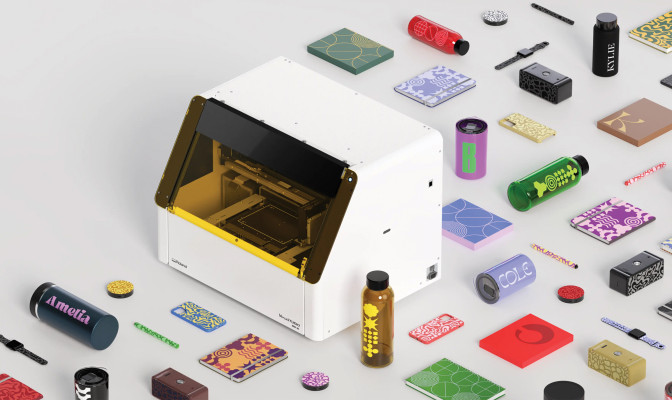


1. Small Footprint
Much of the equipment wide-format PSPs have in their facilities is big. That means it can be difficult to find more space for a new machine — at least unless you have the means for expansion.
However, one of the top perks of tabletop UV printers is right in the name.
“You can place it on a table or desk somewhere and still get pretty good value out of the output with it,” says Emilio Rangel, product manager at Mutoh, which is an exhibitor at PRINTING United Expo.
2. Versatility
Another boon of tabletop UV printers is the range of applications wide-format PSPs can print with these machines.
For instance, with Epson’s SureColor V1070, PSPs can print on substrates outside of the range of a standard printer.
“If you have uneven surfaces or textures or items that you want to print on — let's say slate or something like that, like a natural stone that has some natural texture — we have a wide gap mode where the print head gap is a little bit higher, and you still get fantastic results and great details — thin lines and stuff like that,” says David Bistrovic, product manager for professional imaging at PRINTING United Expo exhibitor Epson America.
The use of UV ink also plays a role in the diversity of materials you can print on.
“Our ink is pretty renowned for — specifically in this space — adhesion qualities, which is huge,” Rangel says. “There's such a wide range of materials and objects. People are putting all sorts of things in these printers to see if they can get the ink to stick to it, and we have pretty good results.”
Some of the materials UV ink can stick to include plastic, metal, wood, acrylic, and more.
In terms of what tabletop UV printers can produce, the list is nearly endless. Some of the common applications are:
● Golf balls
● ADA/Braille signage
● Awards and trophies
● Pens
● Phone cases
● Multilayer backlit signage
● Customized items
● Stickers
● Interior signage
● Yard signs
● Ornaments
● Key chains
● Bottle openers
For printers that have an add-on cylindrical unit, the list expands to items like cups and water bottles.
3. Easy Upkeep
Sometimes, printer maintenance can be a headache. Luckily, it’s often easy with a tabletop UV printer.
“It has an automatic fabric wiper system, so there's really no manual maintenance needed from the operator side,” Bistrovic says of the SureColor V1070. “It does basically the self-maintenance, it cleans the print head automatically. And what it also does: Once it cleans the print head with the fabric wiper, the UV light cures the ink and then just winds it up, so you never are exposed to any wet ink.”
The ease of maintaining a tabletop UV printer means it can become a dependable piece of your operation without needing a whole lot of attention.
“I think it just comes down to consistency and reliability,” Rangel says. “If you have a printer that you can count on; that you know is going to work; that you know is easy to maintain; that you know the ink is going to stick to a wide variety of materials; that you know, when you're posed with a new type of job that you haven't done in a while, and you can kind of pretty quickly figure out how to do that with the workflow system that we have — I think that's probably the most important thing.”
4. Time Savings
Having an efficient wide-format operation isn’t something that is nice to have, it’s a necessity nowadays. With tabletop UV printers, you can save time on jobs and boost your overall productivity.
“If you’re trying to do a regular yard sign with cut vinyl or anything like that, you have to print it, laminate it, mount it, and you're spending all that time,” says Philip Chu, product manager at Roland DGA, also a PRINTING United Expo exhibitor. “Whereas, you get an MO-240 or something like that, you can print directly to that sign, and in about five to seven minutes you can print [the] full side. Flip it over, get the other side, and you're done.”
5. Filling the Gaps
In a world trending toward shorter and shorter runs, tabletop UV printers are ideal for balancing the demand for short runs with the continued necessity of larger jobs.
“Depending on the needs of the customers, they can focus their smaller runs or their medium-size runs on these printers instead of taking up the big machines to do them,” says Hugo Gonzalez, senior segment specialist at PRINTING United Expo exhibitor Mimaki USA.
Gonzalez adds that doing customized work and variable data printing on a tabletop UV printer is also much more manageable than doing it on a large-format machine.
Additionally, a small UV printer can serve as an ideal testing ground for new ideas.
“I would say for a small UV, it frees your large machine for work that's already for paying customers — your bread and butter, so to speak,” Chu says. “It can continue to do that while you can work on prospective customers or different items that are like, is this going to work or is this not going to work?”
When it comes down to it, the combination of the small footprint and the versatility of tabletop UV printers opens a whole new world of possibilities for wide-format PSPs.
“I would say most print shops can find space to put it in their shop, which will open up for them new revenue streams which they traditionally probably would not be able to print,” Bistrovic says. “Let's say they're just printing roll-to-roll, and they might want the big UV flatbed — don't have the space, don't have the capital right now. You could still open new revenue streams with doing UV-printed items.”
Tabletop UV Printers on the Market
Now that we’ve gone through the benefits of small UV printers, here’s a sample of what you could add to your own operation.
Epson
Product name: SureColor V1070
Bed size: 8.3x11.7˝
Maximum media thickness: 2.7˝
Ink: UltraChrome UV ink
Key features: Vacuum bed to keep substrate in place during printing. Has a wide gap mode for uneven surfaces and textures.
Mimaki
Product name: UJF series, consisting of the UJF-7151 plus II, UJF-6042 MkII e, UJF-3042 MkII e, and Kebab HS add-on
Bed size: Range from 12x16.5˝ to 20x28˝; Kebab HS can handle cylindrical objects up to 3.9˝ diameter, 11.8˝ length, and 7.5° taper
Bed height: Up to 6˝
Ink: UV-LED rigid and flexible inks
Key features: Direct-to-object printing. Can print special effects like textures.
Mutoh
Product name: XpertJet 461UF
Bed size: 19x13˝
Bed height: Up to 5.9˝
Ink: US11 and UH21 inks
Key features: Inks are compliant with California Proposition 65 and the CPSIA (Consumer Product Safety Improvement Act), meaning they can be used on things like children’s toys. Optional vacuum table. Can add a rotary unit for cylindrical prints.
Roland
Product name: MO-240, MO-180, and BD-8
Bed size: 24x18˝, 18x12˝, and 8.27x5.83˝, respectively
Bed height: 8˝, 8˝, and 4.02˝, respectively
Ink: V-BOND UV inks for the MO series and ECO UV inks for the BD-8
Key features: Use VersaWorks 7 RIP, which is used on its other machines and can be connected to four different devices without an additional license. Air filter to help with the odor of UV inks.
Kalie VanDewater is associate content and online editor at NAPCO Media.
 Supreme Graphics Becomes First in North America to Install Skandacor’s FINISHpro 3D 1623
 Sun Chemical Showcases Full Digital Portfolio at PRINTING United Expo 2025
 DPI Laboratory Disrupts UV Printing Market with All-in-One Business-ready Package
 INX to Introduce new Screen and Pad printing Inks at K2025
 Printing ADA-Compliant Braille Like an Expert
 Roland DGA Announces New Ink and Functionality Enhancements

