


Why Printers Are Emerging as a Major Channel for Promo Suppliers


The following article was originally published by Promo Impressions. To read more of their content, subscribe to their newsletter, Promo Impressions.
Convergence. You keep hearing about it, and you might wonder what it means for promotional products suppliers. As commercial, wide-format, and apparel printers continue to see the opportunity in promotional products, they're looking to partners to help them bring this offering to their customers.
That growing interest was the focus of a session Joan Miracle, executive director of corporate accounts at ASI, held at PRINTING United Expo 2026 titled, “The $28 Billion Opportunity: What Printers Need to Know About the Promo Products Industry.” In the session, Miracle offered a market-entry primer for print providers that are new to promo or have never seriously considered adding it.
Drawing on 17 years of industry experience, Miracle shared the structure of the growing $28B-plus market, showing demand spread across a wide range of buyer segments, led by education (13.1%) and healthcare (8.3%), along with construction, manufacturing, financial services, hospitality, technology, government, retail, and others. Her core message was that print providers’ existing clients are already buying promotional products, allowing printers to capture more of that business rather than sending it elsewhere.
“If you are not offering promotional products, they [customers] will go elsewhere, and that elsewhere can be a promotional products distributor that does not have printing equipment, and does not have a sales room, and will attempt to sell them the print items,” Miracle told printers in the session.
Miracle highlighted top-selling categories to prioritize when getting started: T-shirts (16.1%), drinkware (10.4%), polos, caps, bags, other wearables, writing instruments, office accessories, and technology, with mobile and non-mobile tech combined representing about 6.6%. She stressed focusing on a few proven categories rather than selling everything, with apparel and drinkware as high-margin items. Industry averages show an order size of about $1,392 and margins of roughly 37.4%, with apparel often reaching about 50%.
For suppliers, those entry-point categories may be where new-to-promo print partners need the most guidance — from product selection and decoration options to inventory and turnaround expectations.
What ASI Data Reveals About Today’s Promo Buyers
Brendan Menapace, content director for Print & Promo Marketing, added another layer to the conversation during his session, "Promo Industry Trends and Emerging Product Categories, by looking at what buyers actually want from promo today. ASI research confirms that apparel and drinkware still anchor the market, with T‑shirts alone representing nearly 15% of all promo sales and drinkware generating about $2.5 billion annually.
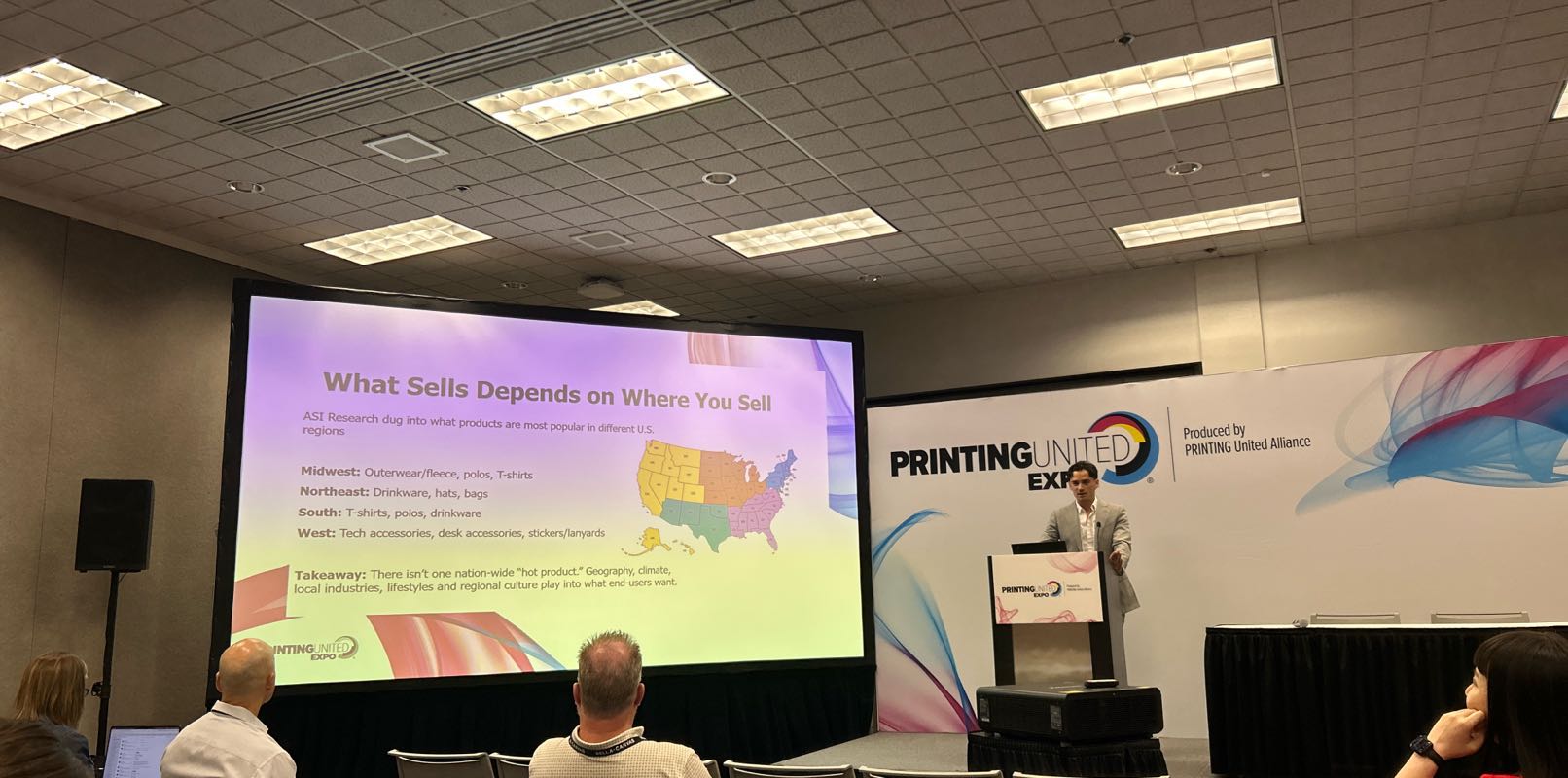
Promotional products popularity by region. | Credit: Allee Bruce
Menapace also stressed that context matters. Preferences vary by region (outerwear and fleece in the Midwest vs. tech and desk accessories in the West) and by generation:
- Gen Z favors identity-driven, socially responsible, and eco-friendly products.
- Millennials lean into practical home and tech tools.
- Gen X and Boomers prefer functional gear, caps, golf items, and travel accessories.
Across all age groups, the winners are promotional products that fit into real daily life. While the products are physical, the path to purchase is increasingly digital, with e-commerce, company stores, and print‑on‑demand personalization becoming table stakes to ensure recipients actually choose and keep the items.
"It's not just younger generations. Everyone is using e-commerce," Menapace said. "Everyone shops online. It is just the way of life now."
Promotional products suppliers can work with printers to set up company stores or branded e-commerce sites where their customers can shop promo, making the integration into promo more successful.
Printers Getting into Promo: Why it Matters for Promotional Products Suppliers
Printers don’t necessarily need to buy new equipment or carry inventory to get started in promo. You, as the suppliers, can be the partner they lean on as they look to say "yes" to more, enabling low-overhead expansion for print shops.
Both printers and promotional products suppliers can leverage ASI’s ecosystem and ESP/ESP+ technology to feature and search products, check live supplier inventory, filter by rush production times, compare pricing, and build presentations. This addresses a top pain point — turnaround expectations — by letting print teams pre‑qualify in‑stock items before pitching promo to their clients.
Printers’ existing strengths, like familiarity with print-ready artwork, color management, and production detail, can also help reduce errors and rework, making them easier partners for suppliers to support.
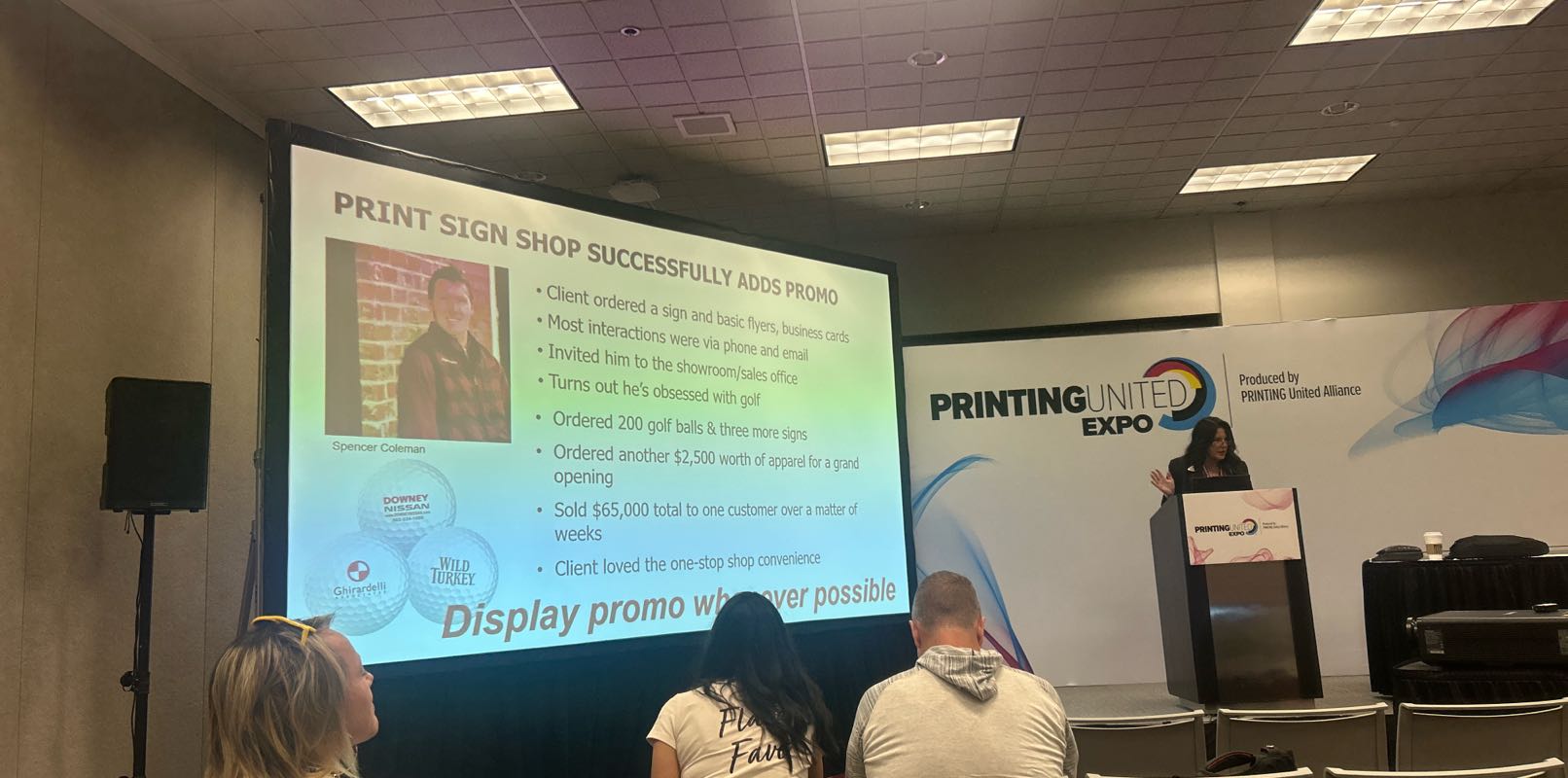
Printer adds promo successfully. | Credit: Allee Bruce
Miracle noted that as more customers bring AI-generated logos and problematic files, printers’ production and graphics experience becomes a real differentiator: "I think there are distributors out there that don't have that print experience and that graphics experience that make those mistakes. I think that's a big advantage that anybody in the print industry has."
Key Takeaways for Promotional Products Suppliers
- Printers are your next big channel. They already own deep client relationships and brand control and bring the print and graphics prowess needed to ensure orders run smoothly. Helping them say “yes” to promo turns them into steady partners.
- Speed and reliability will decide who wins. Suppliers with visible live inventory and fast-turn programs will be the ones printers trust when every job is “rush.”
- Market to printers. Keep the top-selling promo products categories at the forefront and highlight why it makes sense for printers to tap into this opportunity.
- Make it easy. Printers want to say yes to more, and promotional products suppliers have the web tools and products to make that integration possible.
- Think of the end-buyer. Region- and generation-specific assortments can help partners move from generic swag to targeted, intentional programs that keep your products in rotation.
- Categories:
- Business Management - Industry Trends
Allee Bruce is the editor of Promo Impressions, a PRINTING United Alliance media brand.


